

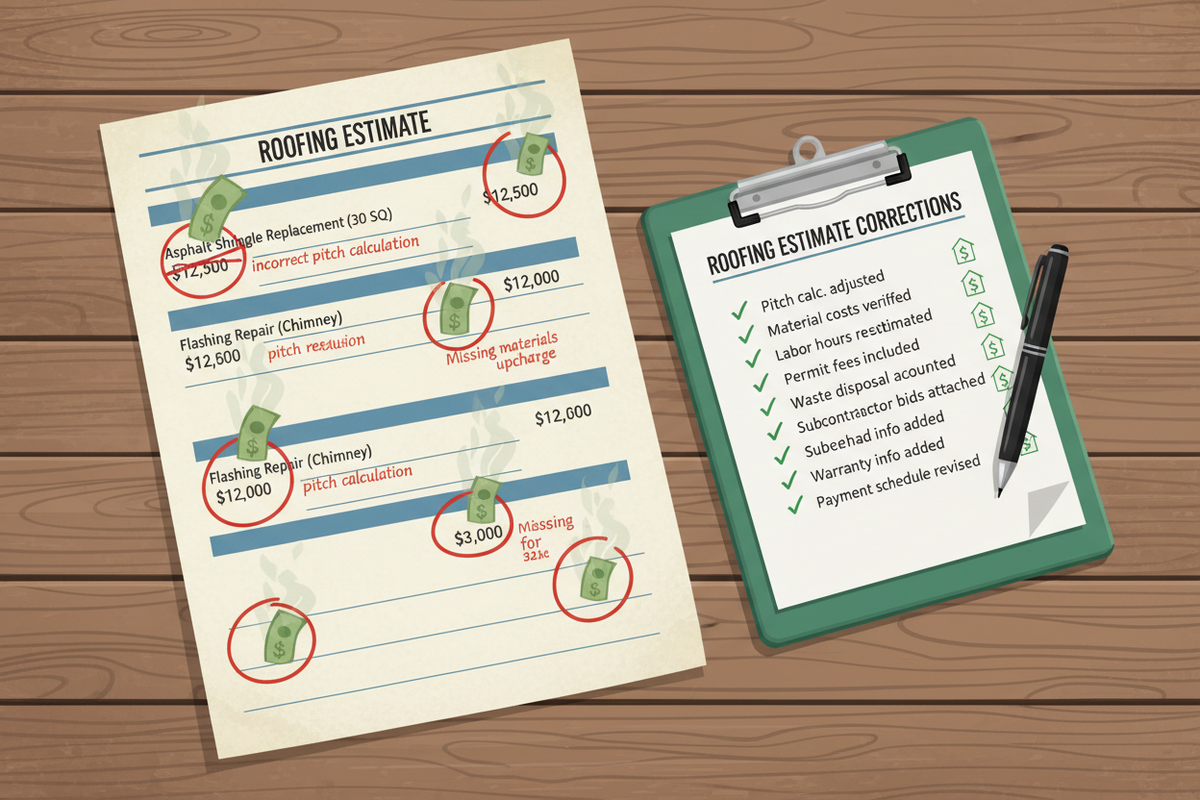
Nobody loses $30,000 in Xactimate all at once. That would be easy to catch.
Instead, it goes like this: a lowball waste factor here, a forgotten steep charge there, an ice & water line entered in squares instead of square feet. Each mistake is small enough to survive review — $150, $400, $800 — and repeated across a hundred claims a year, they quietly add up to a crew's annual payroll.
The good news: the mistakes are remarkably predictable. The same handful shows up in estimate after estimate, which means you can systematically eliminate them. Here are the nine most common Xactimate mistakes roofers make, roughly ordered from "before you type anything" to "before you hit submit."
1. Estimating on the Wrong Price List
The mistake that poisons everything downstream. Xactimate pricing is regional and updated monthly — using last quarter's list, or the wrong region entirely, prices the whole estimate wrong. Best case, you underprice every line a few percent. Worst case, the carrier's reviewer flags the mismatch and your credibility takes the hit.
The fix: Verify the price list and date of loss during project setup, every time. It's a ten-second check in Parameters (Ctrl + R) — stage one of our 30-minute estimate workflow for exactly this reason.
2. Accepting the Default Waste Factor
Carriers commonly write shingle lines at 8–10% waste. That's plausible for a simple gable. It is not plausible for a cut-up roof with hips, valleys, dormers, and short runs — where legitimate waste can hit 15% or more.
Waste hides inside the line item, which makes it the least visible money on the entire estimate. On a 30-square laminate roof, the gap between 10% and 15% waste is real dollars you either documented or donated.
The fix: Calculate waste from the actual roof geometry — your aerial report gives you facets, hips, and valleys for a reason — and document the justification in line item notes (F9).
3. The Felt Suffix Mix-Up
The classic. Xactimate's main shingle lines come in two flavors: base codes that include felt, and "S" variants that exclude it. Pick the with-felt code and then add separate underlayment lines, and you've double-dipped — hello, carrier pushback. Pick the without-felt code and forget the underlayment lines, and you just installed synthetic for free.
The fix: Decide your underlayment scope first, then pick the shingle code to match. Our line item codes cheat sheet covers the suffix logic in detail.
4. Units Confusion: SQ vs. SF vs. LF
Ice & water shield is measured in square feet. Shingles are in squares. Drip edge, starter, and ridge cap run in linear feet. Pipe jacks are each. Enter an SF item as SQ and you've overstated it 100x (instant credibility damage); enter it backwards and you've understated it 100x (instant margin damage).
The fix: Learn the unit for each core item — it's one column on the cheat sheet — and gut-check any line whose total looks weirdly large or small before moving on.
5. Forgetting Steep and High Charges
If your crew is in harnesses on a 9/12 two-story, your labor cost went up whether the estimate says so or not. RFG STEEP and RFG HIGH exist precisely because pitch and height cost real money — and they are among the most forgotten items in the entire industry, by adjusters and by roofers writing their own scopes.
The fix: Make pitch and stories a mandatory field in your inspection notes, and make both charges standing members of your macros so they're present by default and deleted only when they genuinely don't apply.
6. Leaving Out the "Invisible Four"
Starter course. Drip edge. Ridge cap. Ice & water shield. Manufacturer-required, frequently code-required — and systematically missing from carrier scopes. When a roofer writes their own estimate from scratch at 9 PM, the same four items vanish just as reliably.
Individually they're a few hundred dollars each. Together, across a season, they're the single largest pile of money roofers leave on the table.
The fix: Stop relying on memory. A complete scope built into a macro cannot forget the starter course, because completeness is baked in before the estimate begins.
7. Building Every Estimate From Scratch
The meta-mistake that enables half the others. Searching out 40 line items one at a time isn't just slow — every manual entry is another chance to grab the wrong code, the wrong variant, the wrong unit. The estimators with the fewest errors aren't the most careful typists; they're the ones who barely type at all.
The fix: Insert, don't enter. Pre-built residential roofing macros drop a complete, correctly-coded scope in seconds, converting your job from data entry to review. Fewer keystrokes, fewer mistakes, faster estimates — this is the rare fix with no trade-off.
8. Weak or Disconnected Documentation
A perfect scope with no photo support is just a wish list. The two flavors of this mistake: photos that were never taken (the pipe jack count nobody verified), and photos dumped in a general folder instead of attached to the line items they justify. Reviewers approve what they can verify in ten seconds and question everything else.
The fix: Shoot to a checklist in the field — elevations, pitch, penetrations, flashing condition, layered close-ups — and attach photos at the line item level with a one-sentence F9 note. Documentation isn't the step after estimating; it is estimating.
9. Skipping the Final Sanity Check
The last mistake is submitting without the two-minute review that would have caught the other eight. A 30-square roof pricing out at 12-square money means something's missing. A totals page that looks too rich means something's doubled.
The fix: End every estimate with the same ritual: Ctrl + T for the Totals Summary, scan for the invisible four, confirm steep/high, check waste, save. Two minutes, every time, no exceptions.
One System Beats Nine Reminders
Notice the pattern in the fixes: not one of them is "concentrate harder." Every durable fix is structural — a checklist, a default, a macro, a reference you don't have to remember.
That's the whole philosophy worth stealing: turn your knowledge into systems, because systems don't have bad days. Put the codes and shortcuts where your eyes already are. Build the complete scope into macros that insert it by default. Run the same two-minute close-out ritual on every estimate.
Then pull up your last five estimates and score them against these nine mistakes. Whatever you find — that's not bad news. That's a raise you're about to give yourself.
Share:
XactGen Roofing: Verisk's AI Roof Estimator Is Coming to Xactimate — Here's What It Means for Roofers