

Xactimate contains more than 10,000 line items. A residential roof claim uses maybe 30 to 50 of them — and the same core codes show up on nearly every single one.
That's the good news: you don't need to know the whole database. You need fluency in a short list. Know these codes cold and two things happen. You write estimates faster, because you're inserting instead of searching. And you read carrier estimates faster — instantly spotting what the adjuster's scope includes and, more importantly, what it conveniently doesn't.
Here are the 15 most-used Xactimate line item codes for residential roofing, what each one covers, and which ones go missing most often.
One honest note before the list: Verisk updates Xactimate price lists monthly, and exact descriptions can vary slightly by region and price list version. The codes below are the long-standing industry standards — but always confirm against your current price list before submitting. (That's true of any code list on the internet, including this one.)
Quick Reference: The 15 Codes
| # | Code | What It Covers | Unit |
|---|---|---|---|
| 1 | RFG ARMV | Tear off, haul and dispose of comp shingles | SQ |
| 2 | RFG 300 | Laminated comp shingle roofing — incl. felt | SQ |
| 3 | RFG 240 | 3-tab (25 yr) comp shingle roofing — incl. felt | SQ |
| 4 | RFG FELT15 / FELT30 | Roofing felt — 15 lb / 30 lb | SQ |
| 5 | RFG IWS | Ice & water shield | SF |
| 6 | RFG DRIP | Drip edge | LF |
| 7 | RFG ASTR | Asphalt starter — universal starter course | LF |
| 8 | RFG RIDGC | Ridge cap — composition shingles | LF |
| 9 | RFG STEP | Step flashing | LF |
| 10 | RFG FLCH | Chimney flashing — average | EA |
| 11 | RFG FLPIPE | Flashing — pipe jack | EA |
| 12 | RFG VMTL | Valley metal | LF |
| 13 | RFG STEEP | Additional charge for steep roof — 7/12 to 9/12 | SQ |
| 14 | RFG HIGH | Additional charge for high roof — 2 stories or greater | SQ |
| 15 | RFG SH1/2 | Sheathing — plywood — 1/2" CDX | SF |
Now let's talk about why each one matters — and where the money hides.
The Core Scope (Codes 1–4)
RFG ARMV is where every replacement starts: tear off, haul, and dispose of composition shingles, priced per square. If the roof has multiple layers, that's not the same line — additional-layer removal is its own item (look for the ADDRM variants), and missing it means eating the labor on layer two yourself.
RFG 300 (laminated) and RFG 240 (3-tab) are your workhorse install lines. Two things to watch:
- The felt suffix. The base codes include felt; the "S" variants (RFG 300S, RFG 240S) exclude it. If you're upgrading to synthetic underlayment or ice & water in larger areas, the "without felt" version plus separate underlayment lines is usually the more accurate scope. Mixing this up double-pays or zero-pays the underlayment.
- The waste factor. Carriers commonly default to 8–10% waste. A cut-up roof with hips, valleys, and dormers can legitimately justify 15% or more. Waste lives inside these line items — it's the quietest place on the whole estimate to lose money.
RFG FELT15 / FELT30 cover traditional felt by weight. Your price list will also carry synthetic underlayment as its own selector — use what's actually going on the roof.
The Perimeter & Detail Items (Codes 5–8) — Where Carriers "Forget"
If you learn one thing from this cheat sheet, learn this: codes 5 through 8 are the most commonly omitted items on carrier estimates. Every supplement company in the industry will tell you the same short list.
RFG IWS (ice & water shield) — required at eaves in cold climates and in valleys per most codes and manufacturer specs. Measured in square feet, not squares — a units mix-up here shrinks the line by a factor of 100.
RFG DRIP (drip edge) — code-required on tear-offs in most jurisdictions, measured by linear foot around eaves and rakes. Routinely missing from initial scopes despite being legally required. Supplement it back, every time.
RFG ASTR (starter course) — required by virtually every shingle manufacturer at eaves and rakes, and not included in the field shingle line. As the old industry line goes: you can't start a roof without it. Carriers leave it off constantly.
RFG RIDGC (ridge cap) — cut-up 3-tabs are not ridge cap, and manufacturers say so. The dedicated ridge cap line, by linear foot along hips and ridges, is the correct scope.
Miss all four of these on one claim and you're often out four figures. Miss them across a season and you've funded someone else's boat.
Flashing & Penetrations (Codes 9–12)
RFG STEP (step flashing) runs by linear foot where the roof meets sidewalls. RFG FLCH (chimney flashing) is priced each, for an average-size chimney. RFG FLPIPE (pipe jacks) covers each plumbing penetration — count them on your photos and make sure the count matches the estimate. RFG VMTL (valley metal) runs by linear foot in open valleys.
The theme with flashing: carriers love to write "reuse existing." Your photos of rusted, bent, or improperly-lapped flashing are what turn "reuse" into these four line items.
The Multipliers (Codes 13–15)
RFG STEEP adds the labor premium for 7/12–9/12 pitches (steeper brackets have their own selectors). RFG HIGH adds the premium for two stories and up. These aren't upsells — they're real labor cost, and they're forgotten on more estimates than any items except starter and drip edge. If your crew needs harnesses and extra time, the estimate should say so.
RFG SH1/2 (sheathing) covers replacing rotted or damaged decking with 1/2" CDX plywood, per square foot. You often can't see decking damage until tear-off — which is exactly what supplements exist for.
From Cheat Sheet to Muscle Memory
Knowing the codes is step one. Having them available at a glance, mid-estimate is what actually changes your speed. Two ways to make that happen:
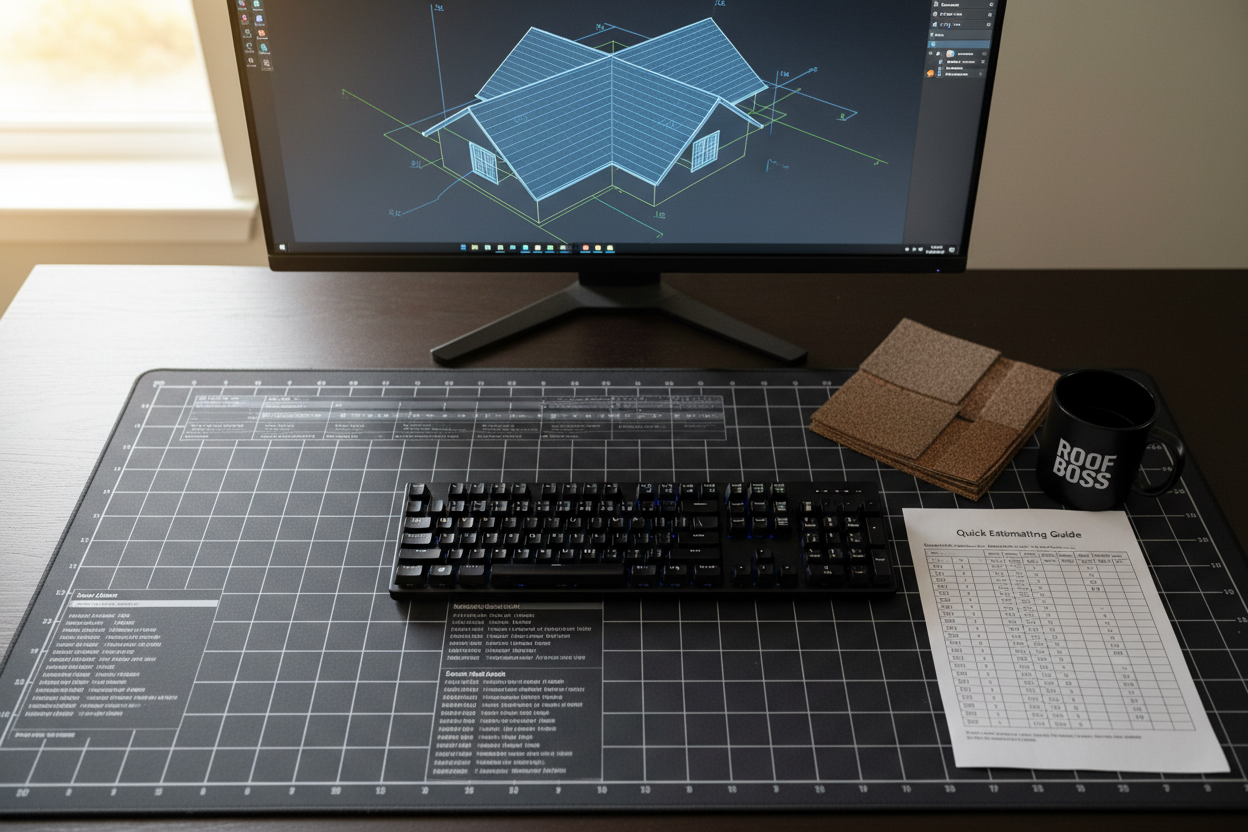
Put the reference under your keyboard. An Xactimate desk mat puts these codes — plus the keyboard shortcuts from our shortcuts guide — permanently in your field of view. No PDFs, no alt-tabbing, no "what was the starter code again?"
Better yet, stop typing codes at all. Every code on this list belongs in your macros. A single residential roofing macro drops the complete scope — ARMV through SH1/2, in order, nothing forgotten — into your estimate in seconds. The cheat sheet becomes your verification list instead of your data-entry list. (New to macros? Start with our Xactimate macros explainer.)
The Bottom Line
Fifteen codes cover the overwhelming majority of every residential roof claim you'll ever write — and four of them (IWS, drip edge, starter, ridge cap) are where carriers systematically underpay. Learn the list, check every carrier estimate against it, and build it into your macros so your own estimates are complete by default.
Print this page, or grab the desk mat version and make it permanent. Then pull up your last three carrier estimates and count how many of the 15 are missing. That number, in dollars, is why this cheat sheet exists.
Share:
Architectural vs. 3-Tab Shingles: What Roofers Should Recommend in 2026
Drip Edge, Starter Strip, and Ice & Water Shield: The Components Homeowners Never See (But Code Requires)