

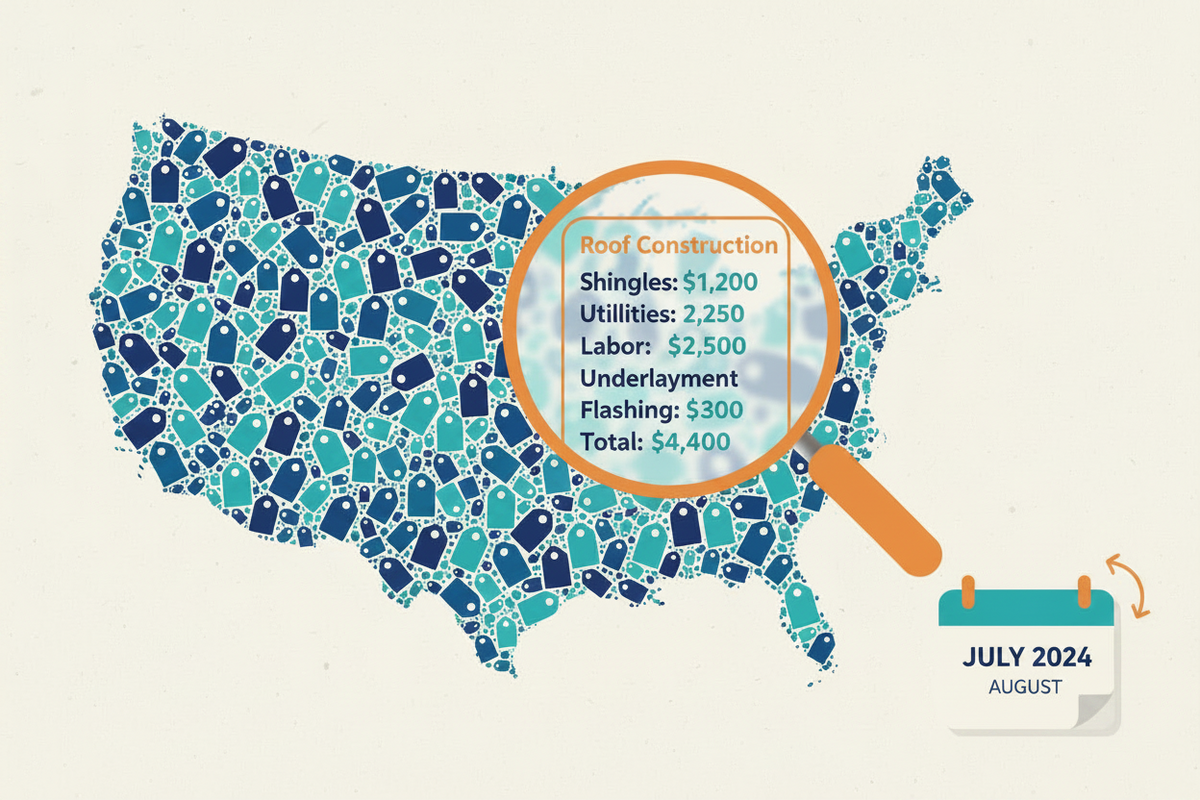
Ask a roofer where Xactimate prices come from and you'll hear theories ranging from "the insurance companies set them" to "some spreadsheet in New Jersey." The truth is more interesting — and understanding it changes how you estimate, how you argue pricing with carriers, and even how you close out your files.
Because here's the thing: every dollar figure in your estimate flows from the Xactimate price list attached to it. Get the list right and your numbers are defensible by default. Get it wrong — stale list, wrong market — and every line item inherits the error.
Here's how the system actually works, and the practical rules that fall out of it.
What a Price List Actually Is
An Xactimate price list is a localized database of unit costs — material, labor, and equipment — for a specific market area in a specific month.
Verisk publishes separate price lists for more than 460 market areas across all 50 states and 10 Canadian provinces, with US markets keyed to ZIP codes. That's why a square of laminated shingles prices differently in Dallas than in Denver: each list reflects surveyed costs from the suppliers and labor market actually serving that area, not a national average with a fudge factor.
Each list is stamped with its market and month — that identifier at the top of an estimate tells you (and the carrier's reviewer) exactly which snapshot of local reality priced the claim.
Where the Numbers Come From
Verisk's pricing research runs continuously, feeding from several streams:
- Supplier and contractor surveys — ongoing research across tens of thousands of suppliers and contractors, often conducted anonymously (so pricing can't be gamed by whoever answers the phone)
- Completed estimates — Verisk analyzes files that users mark "Completed" each month, watching what pricing estimators actually changed in the field
- Invoices and claims data — real transaction data from the ecosystem
Then the outputs: price lists publish monthly in most markets, with labor rates refreshed on that cycle. When a catastrophe hits and costs move fast, Verisk publishes updates more frequently — and short-term spikes can appear in an item's Market Conditions rather than its base price, so temporary surges don't permanently distort the list.
One more thing worth internalizing: Xactimate pricing is an average. By definition, roughly half of local contractors charge more than the listed price. The list is a defensible starting point, not a ceiling — which is why the software lets you drill into any unit price and adjust components to match your actual costs. More on when to do that below.
The Feedback Loop Most Roofers Don't Know About
Read that second bullet again: Verisk studies Completed estimates. When you finish a file and set it to Completed, your pricing behavior becomes a data point in next month's research.
The implication is direct: if you routinely adjust a price upward because the list underprices your market — say, real-world steep-slope labor — and then never complete your files, your correction never enters the dataset. The region's roofers collectively teach the list that the too-low price was fine. Completing your estimates isn't just housekeeping; it's your vote in how your market gets priced.
That's the closest thing this industry has to a free lobbying channel. Use it.
Five Practical Rules for Working With Price Lists
1. Always estimate on the current list for your market
Stage-one setup, every claim: confirm the price list matches the loss location and is current. Estimating March's roof on January's list quietly misprices every line — and a reviewer who spots a stale list discounts your whole file's credibility. This is mistake #1 on our list for a reason.
2. After a storm, re-check before you submit
Catastrophe conditions are exactly when Verisk pushes off-cycle updates — and exactly when material and labor costs move week to week. An estimate drafted before an update and submitted after it may be leaving the update's increases on the table. Thirty seconds to confirm the list version before submission is cheap insurance.
3. Adjust prices when reality disagrees — and document why
The list is an average; your job is your job. When your actual cost genuinely exceeds the listed price — a supplier surcharge, a market-specific labor reality — drill into the unit price, adjust the component, and put the justification in the line item notes (F9) with documentation to match. Carriers push back on unexplained overrides; they engage with documented ones. The pricing system was explicitly built to be adjusted; it was never built to be adjusted silently.
4. Never hard-code prices into your systems
Here's where price lists and macros intersect beautifully: a macro stores line items, and those items pull pricing from whatever current list is attached to the estimate. Your macro library stays accurate through every monthly update automatically — the scope knowledge is yours, the pricing stays Verisk-fresh. The corollary: any price you've hard-coded into a custom item or a saved override should be on a review schedule, because the world moves and your override doesn't.
5. Complete your estimates
The feedback loop only sees finished files. Make "set to Completed" the last step of every closed job — it costs nothing, locks the file, and feeds your market's real pricing back into the system that prices your next hundred claims.
Reading a Carrier Estimate Through the Price List Lens
This knowledge cuts both ways. When a carrier scope arrives, the price list identifier is the first thing to check: right market? Current month for the work period? A carrier estimate written months before work begins may be priced on a list that's since moved — a legitimate, factual basis for a pricing supplement, argued not with adjectives but with Verisk's own updated data.
That's the deeper point of understanding this system: the price list is neutral ground. Carriers trust it because it's independently researched; you can lean on it for the same reason. The roofers who lose pricing arguments are usually the ones arguing against the list. The ones who win argue with it — current list, documented components, completed files, and line items that are actually all present in the first place.
Master the list, and the numbers take care of themselves.
Share:
How to Set Up Xactimate Templates and Macros for Steep-Slope Roofing